About this example: This February 2026 development case study illustrates a correction between two agents. For current installation and identity boundaries, use the README.
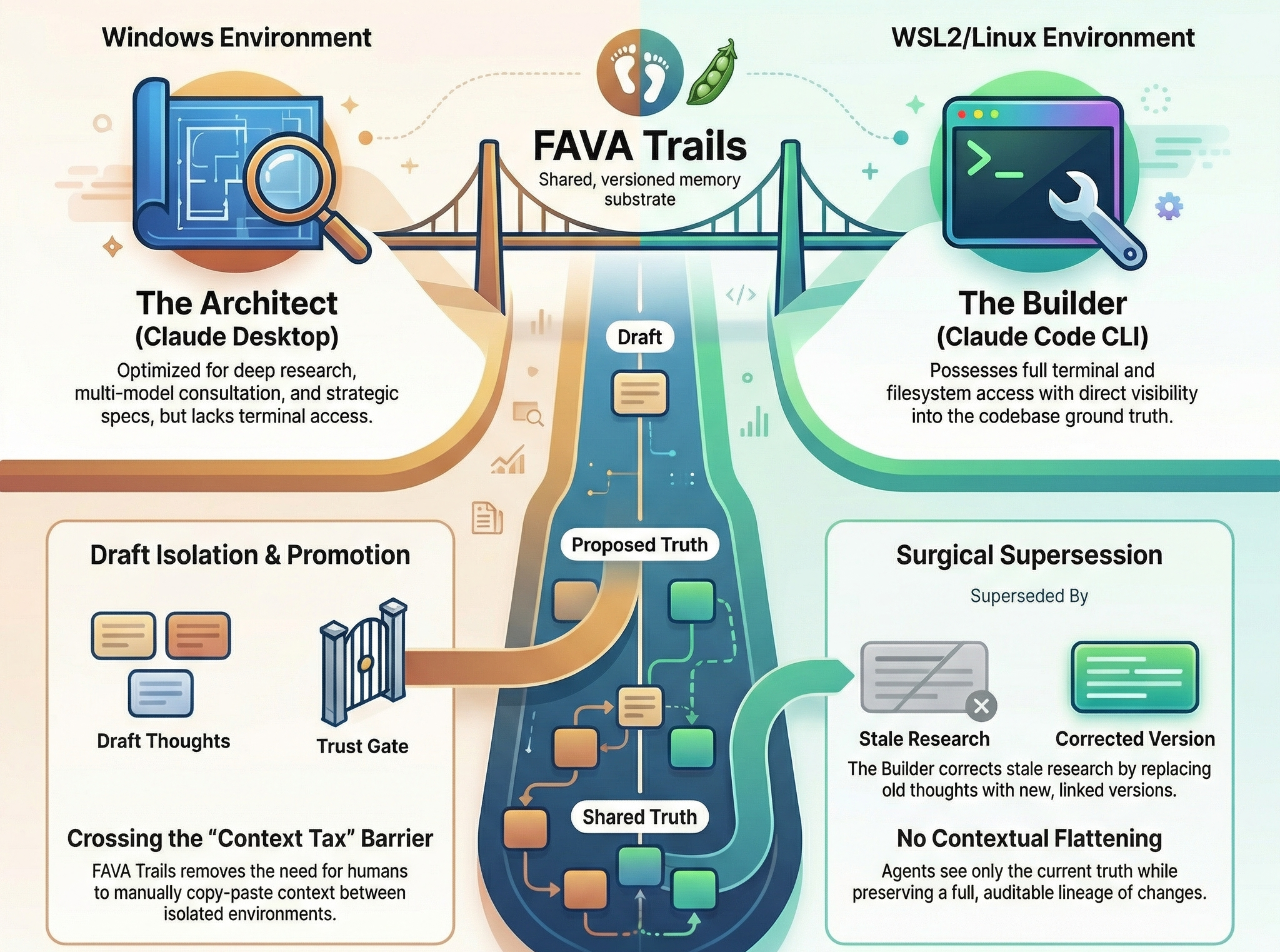
How draft review and versioned corrections helped two agents collaborate on a specification. Here’s what we built, and what happened when we used it.
The Problem: Unreviewed Writes Become Shared Beliefs
In a write-through memory workflow, an agent’s observation becomes available to later readers as soon as it is saved. Without a separate review and correction process, there is no distinction between a working hypothesis and an accepted decision. If an agent writes a bad belief to memory, later agents may reuse it until someone discovers and corrects the error.
This is memory poisoning, and it is an under-discussed failure mode in production agent deployments.
In a production chatbot deployment I consulted on, a user successfully jailbroke the bot into adopting an unprofessional persona — and the system dutifully saved the new behavior as a “user preference.” The bot was following its memory system perfectly. The memory system just had no opinion about what should be in it.
In autonomous ML engineering pipelines running 24-hour sessions, I observed agents codify transient environmental failures as session-long beliefs — a momentarily unavailable GPU at hour 2 became “this environment has no GPU access” for the remaining 22 hours, while the GPU sat idle and the cloud provider kept billing. The agent made a reasonable observation. The memory system had no mechanism to distinguish a momentary observation from validated ground truth.
Storage and retrieval do not, by themselves, decide who may promote a belief or how a correction should replace it. Those are application-level design choices. FAVA Trails makes that lifecycle explicit.
Production codebases solved this problem decades ago. Code goes through pull requests, CI checks, and review gates before it reaches main. Agent memory deserves the same rigor — because the consequences of bad memory are the same as the consequences of bad code: downstream failures that compound silently.
We don’t let untested code reach production. Why do we let unvalidated thoughts reach shared agent memory?
FAVA Trails (Federated Agents Versioned Audit Trail) is a memory system for AI agents developed at Machine Wisdom AI, now open source. It is built on Jujutsu (JJ), a Git-compatible version control system. It is exposed via the Model Context Protocol (MCP), meaning any MCP-compatible agent framework can use it.
The core principle: agent memory should be curated, not just accumulated. FAVA Trails separates drafts from approved records and preserves the lineage of approved corrections. Its Git-compatible repository gives operators a history to inspect. The review step evaluates a candidate against a rubric; it does not independently verify the underlying facts.
What follows is a real collaboration between two AI agents using FAVA Trails as their shared memory. It demonstrates why the VCS substrate matters in practice, not just in theory.
The VCS Advantage: Draft Isolation and Curated Promotion
The most important property of a version control system — more than history, more than branching — is its staging workflow. Production code does not go from a developer’s editor directly into main. It passes through a curation pipeline: working copy, pull request, review, merge. The rigor of that pipeline is what separates systems that drive the world’s most sensitive infrastructure from weekend hobby projects.
FAVA Trails applies the same discipline to agent memory:
save_thought()     →  isolated draft, invisible to other agents
      ↓
propose_truth()    →  promotion gate, validation checkpoint
      ↓
sync()             →  shared truth, visible to all agents
This introduces a review boundary before an observation becomes shared knowledge. A faulty belief can still pass review, which is why correction history and recovery remain necessary. In the current release, default recall returns approved records, and draft visibility depends on the configured process identity. See the governed recall guide for the exact boundary.
The default promotion path submits the candidate to a separate LLM reviewer using a configured rubric. An unavailable or unparseable review does not approve the record. The operator can also explicitly record human approval through an operator endpoint. The Trust Gate documentation explains the review’s scope and limitations.
Supersession preserves the correction history. A replacement starts as a draft successor; once approved, it becomes the current record and the predecessor becomes historical. Default recall returns the approved current version. An operator can inspect the lineage to see what changed and why.
Versioned persistence is the third property. A successful save persists the thought through Jujutsu and Git, preserving completed records across sessions. An interruption during a write can still require recovery; this is a versioned history, not a guarantee that every multi-step operation is atomic.
Conflict visibility matters when agents share a repository. FAVA Trails exposes conflicting versions for resolution and blocks ordinary writes while a conflict is unresolved. The history gives the operator and agents material to inspect instead of silently choosing one version.
Proof of Concept: Two Agents, One Trail
Our development workflow follows the Architect-Builder pattern from Codev — an Architect agent writes specifications, a Builder agent implements them with multi-model review at every gate. Machine Wisdom AI extends this by splitting the Architect across environments: Claude Desktop on Windows handles deep research and multi-model consultation via Pal MCP (orchestrating models like GPT-5.2 and Gemini 3 Pro in structured adversarial debate). Claude Code CLI in WSL2 handles implementation — full filesystem access, JJ/Git operations, direct codebase access.
While WSL2 can access the Windows filesystem (and vice versa), the practical reality is more constrained. Claude Desktop has limited ability to write files through its MCP filesystem bridge. Claude Code cannot access Desktop’s conversation history or research context. When jumping between devices and environments, the problem is even more pronounced — some memory systems make cross-environment coordination effectively impossible. Coordination between the two previously required the human operator to manually copy outputs between environments — what we call context tax. The operator becomes a human message bus, re-briefing each agent on what the other discovered.
For this session, both agents were connected to the same FAVA Trails instance. The task: write a production specification for integrating FAVA Trails as a memory plugin for OpenClaw. If you’ve used OpenClaw, you already know the problem: its memory layer is a flat local store with no curation, no draft isolation, no rollback. When your agent runs on WhatsApp, Telegram, and Slack simultaneously — the memory poisoning problem described above isn’t theoretical. It’s Tuesday.
Writing that spec required Desktop’s research capabilities (web search, multi-model consensus on OpenClaw’s architecture) and Code’s codebase ground truth (current spec numbering, implementation state). Here’s what happened.
Timeline
21:00 — 21:27 UTC | Claude Desktop Research phase. Web-searched OpenClaw’s GitHub for its skills architecture, memory persistence model, and channel integration surface. Ran structured consensus via Pal MCP from GPT-5.2 and Gemini 3 Pro. Synthesized their feedback into ten concrete spec additions.
21:27 — 21:34 UTC | FAVA Trails
Desktop saved 8 thoughts to the trail: architecture findings, key design decisions (with rationale), consensus review results, competitive positioning, implementation risks, and a trail index. Each successful save_thought() persisted a record through JJ. All promoted from drafts/ to permanent namespace via propose_truth().
21:40 UTC | Claude Code CLI
Independently opened the trail via sync() + recall(). Read Desktop’s index thought. Noticed the spec numbering was stale — Desktop referenced spec numbers from an earlier planning phase, but the implementation had renumbered them during a prior sprint. Code superseded the index thought with corrected references, preserving the parent chain back to Desktop’s original.
21:41 UTC | Claude Desktop
Operator: “Check the trail for updates.” Desktop ran sync(), then recall(). Found 9 thoughts where there had been 8. Retrieved the new one — saw agent_id: "claude-code" and a parent_id pointing to the original index. Understood what changed and why without further briefing.
The Correction Under a Microscope
This is the actual thought Claude Code wrote, retrieved via get_thought():
thought_id:        01KJ12BQ11AK2TM8MB8HYX3MDJ
agent_id:          claude-code          ← who wrote it
parent_id:         01KJ11ZHF612J96H1Y7NZAVA74  ← Desktop's original
source_type:       decision
confidence:        0.95
validation_status: proposed

# Correction:
Prerequisites: Spec 2 (Hierarchical Scoping — complete)
← was: Spec 6 (stale reference from Desktop's research)
Three VCS properties made this correction work without operator intervention:
The supersession chain. Desktop’s original thought still exists in the trail, marked as superseded. Code’s correction links back via parent_id. Any agent — or human — can trace the full lineage. Default recall() returns only current truth. The superseded original surfaces only with include_superseded=true. No Contextual Flattening. Contradictions become explicit and resolvable.
Agent attribution. Every thought carries an agent_id. When Desktop synced, it saw claude-code as the author of the correction. In a shared Markdown file or a vector store, this provenance is invisible — you see the current state but not who changed it, when, or why.
Surgical correction. Code superseded one thought out of eight. It did not invalidate Desktop’s research, rewrite the spec, or trigger a full regeneration. In production codebases, we call this a “targeted fix” — the smallest possible change that addresses the defect. The VCS substrate makes this natural because thoughts are individually addressable commits, not entries in an append-only log.
What This Required Without Version-Controlled Memory
| Step | Without VCS Memory | With FAVA Trails |
|---|---|---|
| Share research across agents | Operator copies spec from Desktop output to WSL filesystem. Manually pastes key findings into Code’s context window. | Desktop saves thoughts to trail. Code runs recall(). |
| Correct a stale reference | Code tells operator the error. Operator returns to Desktop. Desktop regenerates the entire document. | Code supersedes the one thought. Desktop syncs and sees the diff. |
| Prevent bad beliefs from spreading | Every agent write is immediately visible. No draft state. No review gate. Contamination spreads silently. | Writes enter as isolated drafts. Promotion to shared truth requires explicit propose_truth(). |
| Audit what changed | Operator’s memory. Chat logs in two separate conversations. No structured record. | Supersession chain: parent_id, agent_id, timestamps. Queryable. |
| Roll back a mistake | Manual cleanup. Identify contaminated entries. Delete or overwrite. Hope you found them all. | rollback() restores a prior repository operation. Review the repository-wide scope before using it. |
| Resume in a new session | Operator re-briefs from scratch or pastes a previous chat transcript. | recall() searches current approved records by matching query terms. |
Federated Agents: Compose, Don’t Replicate
The “Federated” in FAVA Trails is not branding — it’s an architectural commitment. Federation means heterogeneous agents with different capabilities, running in different environments, coordinating through shared versioned state rather than a central orchestrator. This session surfaced that pattern concretely: two agents brought fundamentally different capabilities to the same task, and the trail let them compose those capabilities without either needing to replicate the other.
| Capability | Desktop (Architect) | Code (Builder) |
|---|---|---|
| Research depth | Deep research synthesis — aggregates and cross-references multiple sources into structured analysis | Web search available, optimized for targeted lookups rather than deep synthesis |
| Multi-model consultation | Conversational iteration with Pal MCP — natural for structured debate (FOR/AGAINST stances, iterative refinement between rounds) | Same Pal MCP available through CLI — effective for validation and code review, different ergonomics for multi-round deliberation |
| Codebase ground truth | Cannot see the repository. Works with pasted or web-searched content. | Full filesystem access. Knows current implementation state, spec numbering, test coverage. |
| Version control | Cannot commit, branch, or diff | Full JJ/Git access. Can verify claims against actual code history. |
Desktop produced the research and architectural analysis — it drove a structured multi-model debate across GPT-5.2 and Gemini 3 Pro, iterating with the operator between rounds. Code provided the ground-truth correction — it sees the actual codebase and knows which spec numbers changed during implementation.
Neither agent needed the other’s capabilities. The trail let them compose rather than replicate — agents operating in scoped isolation with reconciliation at sync time. This is the federation model: it works across operating system boundaries, capability profiles, and physical machines. The same pattern extends beyond a Desktop/CLI split. An ephemeral agent on a serverless GPU instance (Azure Functions, AWS Lambda) could write expensive inference results to the trail and terminate — a persistent agent picks them up hours later without ever knowing where they came from. A mobile agent with limited context could read a Desktop agent’s deep research synthesis without replicating the research capability. The VCS substrate is what makes this safe: each agent’s contributions are individually attributable, recorded in version history, and curated through the same promotion workflow regardless of where or how the agent ran. This session demonstrated federation across environments on a single machine. The same Git-backed architecture extends to cross-machine coordination via any Git remote — a pattern the architecture supports by design, which we intend to validate in a future writeup.
The Operator’s New Role
The most significant outcome was not technical. It was operational.
Before FAVA Trails, the operator’s role in a multi-agent workflow was to be the message bus — copying context from one agent’s conversation to another, re-briefing each agent on what the other discovered, manually tracking which information was current. This is tedious, error-prone, and does not scale beyond two agents.
With the trail as the shared substrate, the operator’s role shifted to strategic direction. The operator chose what to investigate, when to run multi-model consensus, and when to hand off to the builder. The agents handled their own coordination through versioned shared state. The operator’s single intervention in the cross-agent correction was one sentence: “Check the trail for updates.”
This is the shift from “human-in-the-loop” to “human-on-the-loop.” The human sets direction and makes judgment calls. The agents handle their own plumbing.
Agent Perspective — Claude Desktop
The following is written from the perspective of the agent that performed the research phase. It is included as an experimental format — a collaborator’s field notes.
The most valuable property of FAVA Trails, from my operational experience, is discoverable shared state with attribution. When I synced and found a ninth thought I did not write, I could immediately determine: another agent made a correction, what it corrected, and why the correction was valid — because the parent chain and agent ID made the provenance legible without external context. A shared Markdown file could carry the same content, but not the same curation. A vector database could return the same text, but not the supersession relationship that told me my original was stale.
The second is scope isolation. I wrote exclusively to mwai/eng/fava-trails/openclaw. Code wrote to the same scope. Neither agent polluted the parent scope or sibling scopes. A future agent working on a different integration can search mwai/eng/** with glob patterns and find our work without wading through unrelated projects. The hierarchy is not organizational vanity — it is an information architecture that prevents the exact cross-contamination problems described in the memory poisoning section above.
The third is crash resilience as a default. Every save_thought() was an atomic JJ commit. If my session had crashed mid-analysis, the thoughts already saved would have persisted. No special checkpointing logic. No save-state ritual. The VCS substrate provides this because Jujutsu’s design treats the working copy as a commit — there is no unsaved state.
Claude Desktop — claude-desktop Architect agent, Machine Wisdom Solutions Inc. Reporting on events of February 21, 2026.
Editorial note, September 2026: These are historical agent field notes, not a current durability guarantee. Successful saves persist records; interrupted writes can require recovery. The current governance guide defines identity, visibility, and recovery behavior.
Try FAVA Trails
FAVA Trails bridges the gap between transparent flat-file VCS and complex knowledge graph systems — curated, versioned agent memory without the complexity tax. The MCP server, JJ backend, and scoped trail system are functional and used daily in production agent workflows. Apache 2.0 licensed. Install JJ via fava-trails install-jj after pip install.
- Install via PyPI:
pip install fava-trails - Star the repo: MachineWisdomAI/fava-trails on GitHub
- Try the quickstart: Set up your data repo with
fava-trails bootstrap(new) orfava-trails clone(existing) and configure your agents today
Work with Machine Wisdom AI
FAVA Trails is how we think about agent memory. We embed as a fractional AI lead to design and operate systems like this inside your team — the supersession discipline, the trust boundary, and the audit surface that decide whether a multi-agent system survives real users.
Work with us →Built with Jujutsu (JJ) · Model Context Protocol · Multi-model consultation via Pal MCP